
Facet Joint Injection vs. Medial Branch Block: What Patients Should Compare
Facet Joint Injections and Medial Branch Blocks serve different goals. Premier Injury Specialists compares the pain source, target area, diagnostic value, and next treatment step before recommending an option. A facet injection treats the joint area, while a medial branch block tests nerves that carry facet pain.
Request an EstimateOptions at a Glance
Facet joint injections and medial branch blocks can both help evaluate spine-related pain. The right choice depends on what your examination suggests and what question the procedure needs to answer.
- Facet Joint Injections are best suited for pain that appears to come directly from an irritated facet joint.
- Medial Branch Blocks are best suited for testing whether small nerves carry pain from the facet joints.
Quick Comparison
Neither procedure is automatically better for every patient. We compare the purpose, target, expected information, and possible next step during the treatment discussion.
| Option / System | Best For | Timeline / Follow-Up | Key Trade-Offs |
|---|---|---|---|
| Facet joint injection | Pain believed to arise within the facet joint | Follow-up depends on pain response and examination findings | Treats the joint area but may not identify which nerve carries the pain |
| Medial branch block | Testing whether medial branch nerves carry facet-related pain | Follow-up depends on the immediate pain response and treatment plan | Provides diagnostic information but may offer limited lasting relief |
1. Facet Joint Injection
A facet joint injection places medication near an irritated facet joint to reduce pain and inflammation. The procedure may also help us judge whether that joint contributes to your symptoms.
Facet joint injections are best for patients whose symptoms and examination point toward a painful facet joint. We review your history, movement pattern, imaging, and other possible pain sources before making that recommendation.
Best for: patients with clinical signs that support facet joint pain and may benefit from joint-focused treatment.
Our Facet Joint Injections service begins with a careful review of your symptoms and treatment goals.
2. Medial Branch Block
A medial branch block places medication near small nerves that carry pain signals from facet joints. The response can help us assess whether those nerves are involved.
Medial Branch Blocks are best for patients who may be candidates for nerve-focused treatment. We compare the pain response with your normal activities and examination findings.
Best for: patients who need to test whether medial branch nerves are carrying pain from the facet joints.
3. How the Goals Compare
Facet joint injections focus on the joint area, while medial branch blocks focus on the nerves that report pain from that area. The main difference is whether the procedure is primarily joint-focused or nerve-focused.
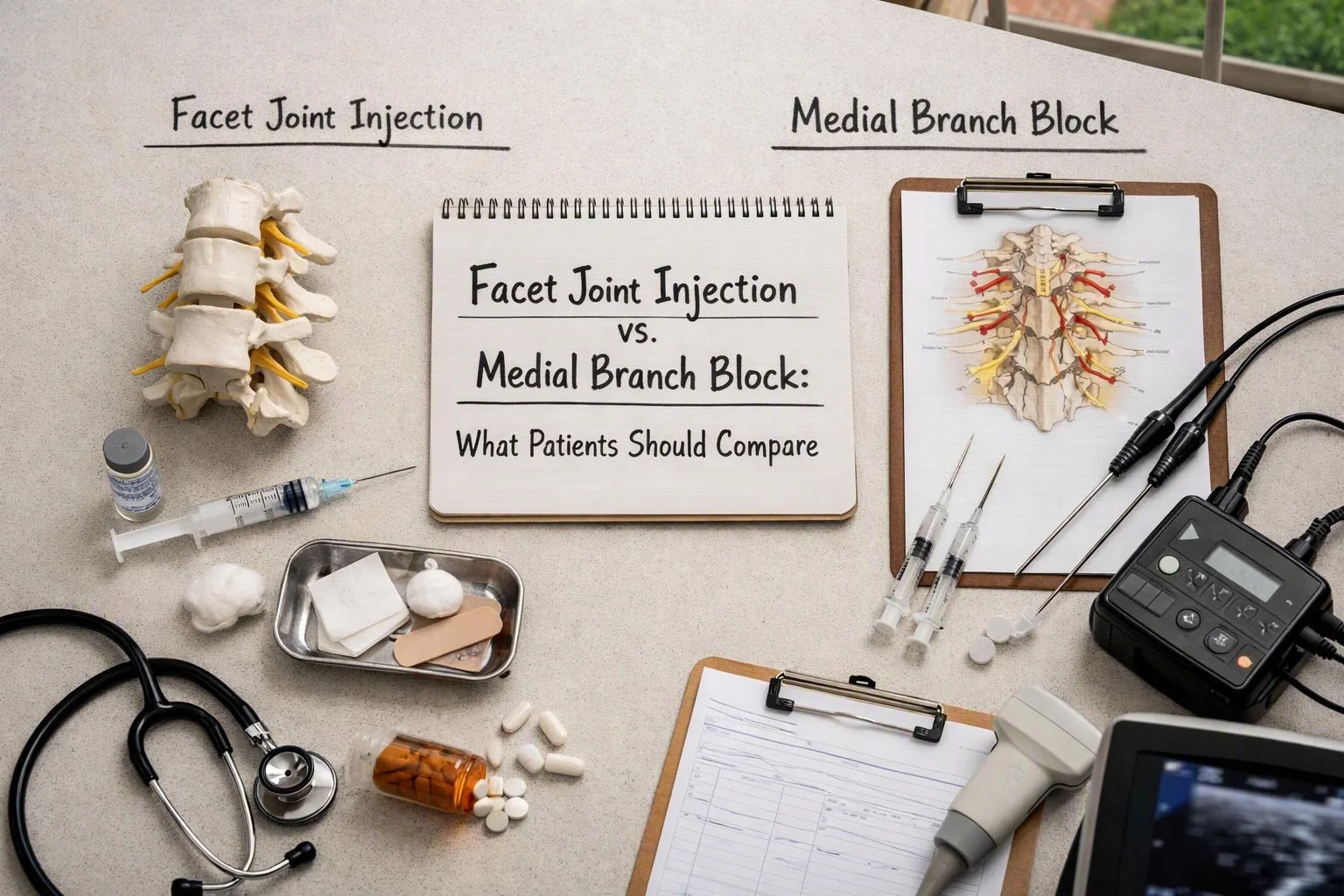
We also consider whether the main goal is symptom relief, diagnostic testing, or planning a future treatment. Your medical history and examination help determine which goal matters most.
4. What Happens After the Procedure?
Follow-up after either procedure depends on your pain response, activity level, and examination findings. We ask what changed, when it changed, and how the response affected your usual movements.
A medial branch block may be used before radiofrequency ablation when the response supports the facet nerves as a pain source. That decision requires careful review, and a block does not automatically mean ablation is appropriate.
What is the difference between a facet joint injection and a medial branch block?
A facet joint injection treats the area around a facet joint, while a medial branch block tests nerves that carry pain from facet joints. The procedures differ in their target and purpose.
We use your symptoms, examination, imaging, and treatment goals to compare the options. The best choice depends on the pain source we are trying to confirm or treat.
Does a medial branch block target the facet joint?
Yes, a medial branch block targets nerves connected with facet joint pain, not the joint space itself.
The medial branch nerves carry pain signals from the facet joints. We use the response to help determine whether those nerves are part of the pain pattern.
Is a medial branch block used before radiofrequency ablation?
Yes, a medial branch block can be used before radiofrequency ablation when the block supports the suspected pain source.
Radiofrequency ablation is a separate treatment that affects targeted pain-sensing nerves. We review the block response and your overall condition before discussing whether that treatment fits.
Which questions should I ask about these procedures?
The most useful questions focus on the suspected pain source, the procedure target, and how the response will guide care. Clear answers can help you understand the reason for each recommendation.
We explain the recommendation in plain language and answer questions about preparation, risks, and follow-up. Contact Premier Injury Specialists to discuss which option matches your symptoms and goals.
Get a Free EstimateRelated Resources
How Imaging Guides Pain Procedures: Fluoroscopy and Ultrasound
What Goes With ItPain Injections: Potential Benefits, Risks, and Recovery
What It SolvesFacet Joint Pain: Symptoms and How It Is Evaluated
What Goes With ItSpine Pain Procedures Explained: Epidurals, Facet Injections, and Nerve Blocks